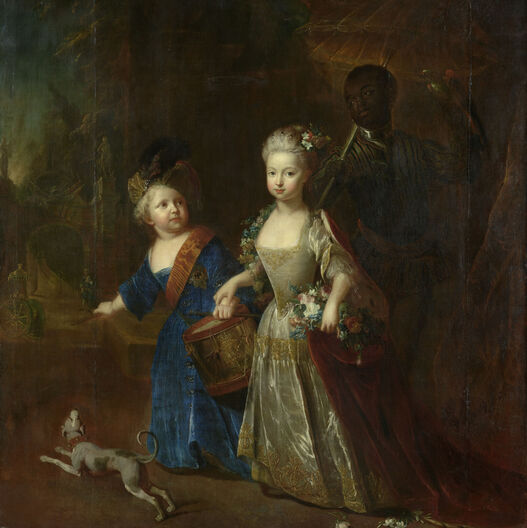
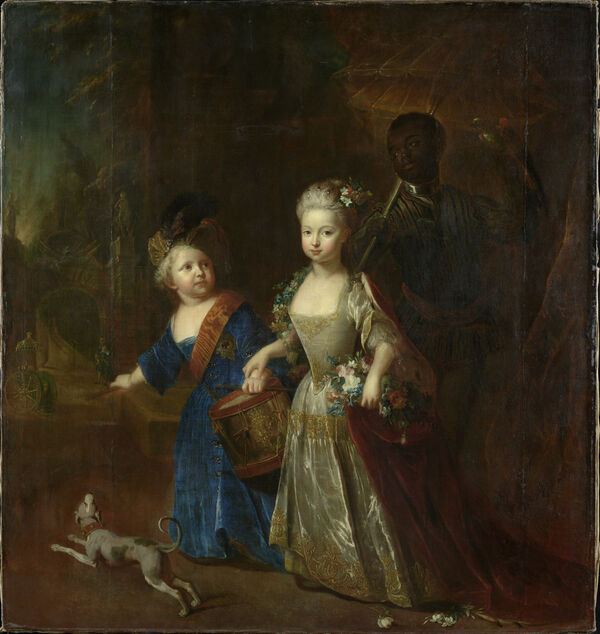
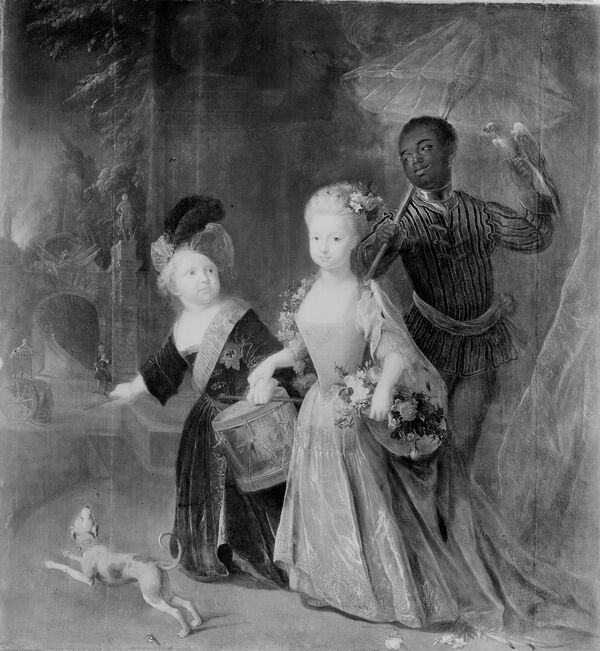
This portrait by Antoine Pesne, dated 1714, depicts a royal brother and sister, five-year-old Wilhelmine and three-year-old Frederick, later Frederick II. They are standing next to a triumphal arch. Their clothing identifies them as royal children. Behind them is a young Black servant. Frederick's right hand, holding a drumstick like a baton, points to the bright light behind the gate decorated with trophies, thus referring to his future role as supreme commander. Wilhelmine, holding a basket of flowers and adorned with a garland, embodies his female counterpart.
The Black valet behind Wilhelmine wears a striped livery and a silver-coloured neck ring. The neck ring here is a reference to bondage and slavery. He holds an umbrella and a parrot. These are motifs that were common in contemporary European depictions and are considered stereotypical attributes from today's perspective. Pesne deliberately contrasted the dark skin tone with Wilhelmine's, emphasising her fair complexion, which was considered elegant at the time. In addition, the serving position of the Black boy, standing behind them and shielding them, highlights the dominant role of the two royal children.
Even though we do not know exactly who the person behind Frederick and Wilhelmine was, there are references to biographies of Black servants living at court at the same time. With their Christian upbringing and subsequent baptism, the acquisition of human beings was legitimised at the time, as it was claimed that this saved them from paganism.