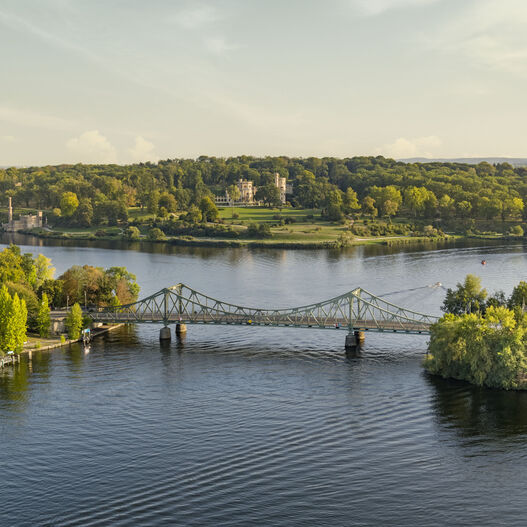
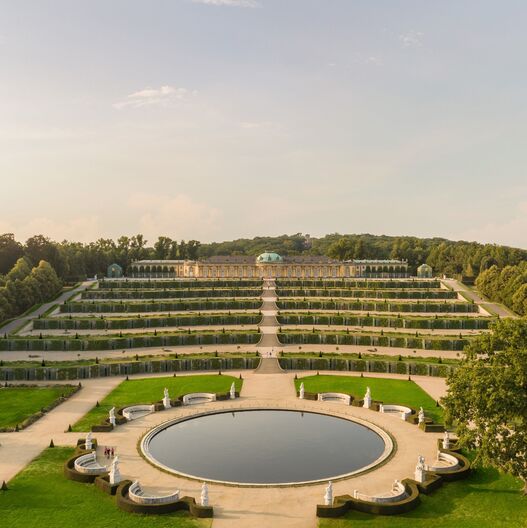
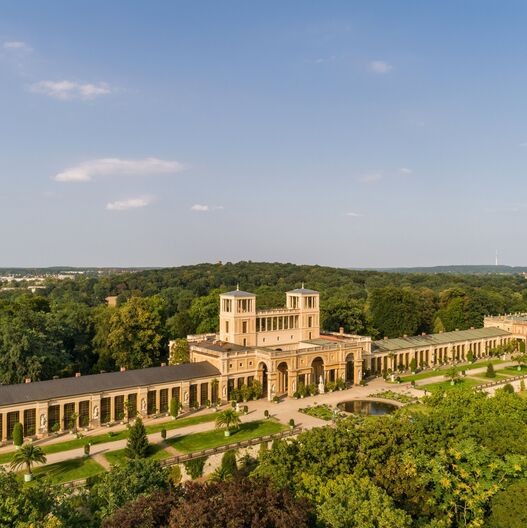
Visitors to the palaces and gardens of Potsdam and Berlin are immersed in a cultural landscape that has inspired people for centuries – and has been a UNESCO World Heritage Site since 1990. A large part of the famous grounds of the Prussian Palaces and Gardens Foundation Berlin-Brandenburg (SPSG) are now part of the world heritage of humanity. This gives them an international seal of approval – both an honour and an obligation – that underlines their special significance as well as their extraordinary beauty.
Between Potsdam-Sanssouci, the New Garden, Sacrow, Peacock Island and Glienicke lies one of the most impressive historical park landscapes in Europe: a place that uniquely combines art, nature and history – and continues to captivate visitors from all over the world.
Prussian Arcadia – an enchanting World Heritage Site
The World Heritage Site ‘Palaces and Parks of Potsdam and Berlin’ is considered a total work of art of international standing. Viewing axes, palaces, water features and elaborately designed gardens combine to create a landscape that is not without reason poetically nicknamed ‘Prussian Arcadia’. Here you can experience how harmoniously architecture and nature merge – and discover the artistic vision behind the Prussian residences.
UNESCO recognised this uniqueness as early as 1990. Receiving a World Heritage designation is rare and demanding: each site must be unique and completely authentic. The Potsdam-Berlin cultural landscape fulfils these criteria in a special way. Over centuries, outstanding architects and garden designers have worked here to create an ensemble that captivates with its successful interplay of architecture and garden design.
12 December 1990 – Inclusion in the UNESCO World Heritage List
The designation as a World Heritage Site is itself a piece of contemporary history: the GDR submitted its application for inclusion as early as 1989. In 1990, the Federal Republic of Germany added further significant sites to the proposal, including Glienicke and Peacock Island. Just two months after reunification – on 12 December 1990 – the UNESCO World Heritage Committee sent a strong signal in Banff, Canada, and added the ‘Palaces and Parks of Potsdam and Berlin’ to the list as World Heritage Site number 532 C (Cultural Property).
A landscape reunited
The designation also marked the beginning of a significant reconstruction effort. Due to the Cold War and its border fortifications, parts of the cultural landscape – for example in Sacrow, Babelsberg and the New Garden – had been severely damaged and inaccessible for a long time. In the 1990s, the SPSG began the careful restoration of paths, areas and historical structures. Step by step, what belonged together grew together again.
Today, the Potsdam-Berlin cultural landscape once again presents itself as an impressively cohesive ensemble. With a total area of 2,064 hectares, it is one of the largest and most beautiful UNESCO World Heritage Sites in Germany.
Expansions in 1992 and 1999 – even more World Heritage to discover
The World Heritage Site has been expanded twice since its initial designation:
In 1992, Sacrow House and Park with the Church of the Saviour were added. In 1999, other historically significant areas were added, which continue to shape the World Heritage Site to this day:
- The Lindenallee west of the New Palace,
- the former horticultural college, the imperial railway station and surrounding area,
- Lindstedt House and Park, including the lowlands,
- the village of Bornstedt with its church and cemetery,
- the Voltaire Path between Sanssouci Park and the New Garden,
- the Allee nach Sanssouci as the historic park entrance,
- the Russian colony of Alexandrowka with Kapellenberg,
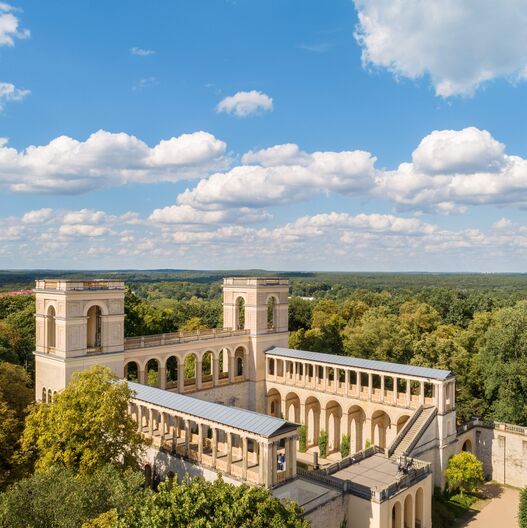
- the Belvedere on the Pfingstberg with the Temple of Pomona,
- the Henckel Villa and its garden,
- the Mirbachwäldchen as a connection between the Pfingstberg and the New Garden,
- the garden of the Alexander Villa,
- and the grounds at the observatory in Babelsberg.