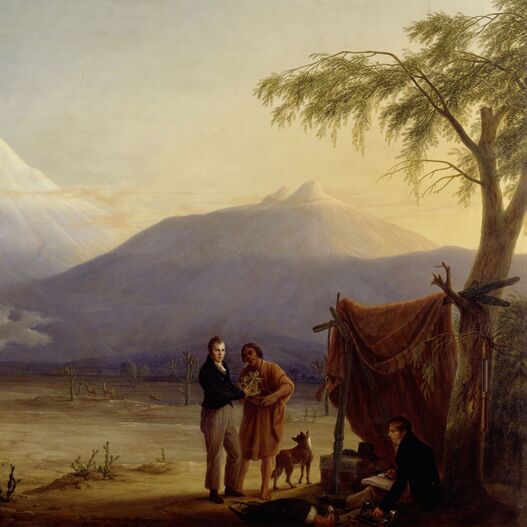
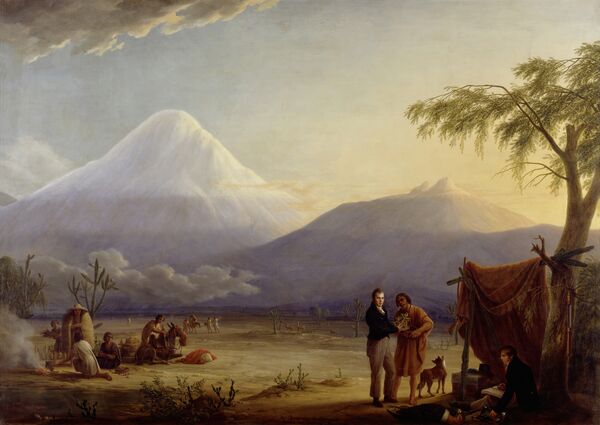
During their trip to America from 1799 to 1804, Alexander von Humboldt and his French colleague Aimé Bonpland spent several days at Mount Chimborazo in what is now Ecuador. In the foreground of the painting, Humboldt stands in European clothing, taking a sextant from an indigenous companion. In the right-hand corner, under a tent canvas, Aimé Bonpland sits with a botanical drum, bent over a book.
In previous descriptions of the painting, the indigenous companion is usually not mentioned at all. However, he clearly has the important task of looking after the scientific instruments. As tall as the European explorer, he forms the centre of the painting together with him, despite his slightly submissive gaze. The scientific instruments that Humboldt and Bonpland carried with them were the guarantors of the success of their research and irreplaceable on the road. Therefore, the guardian of the instruments was given a prominent position. Letters and reports reveal that José de la Cruz from Cumaná accompanied the expedition group throughout the journey as a servant and porter.
In his extensive descriptions of his journey through South America, Humboldt rarely mentions the indigenous inhabitants. This led his European contemporaries and posterity to believe that Humboldt and Bonpland entered uninhabited areas and explored nature there.
Friedrich Georg Weitsch's painting conveys a different picture. The depiction of José de la Cruz in the centre of the picture next to Humboldt emphasises how much Humboldt actually depended on the support of the local people. The fact that José de la Cruz is not mentioned in the title or in the reception of the painting shows, however, that this was not recognised in Europe.