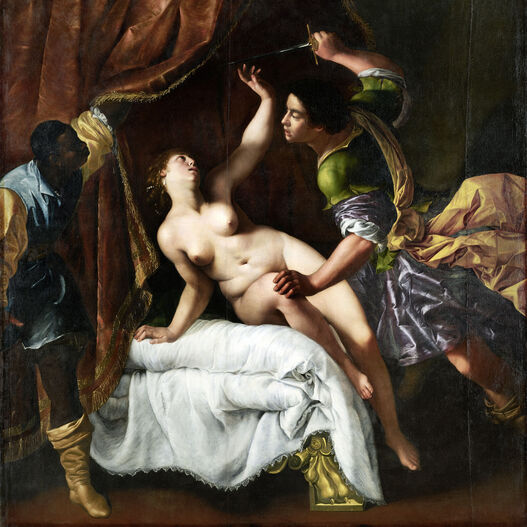
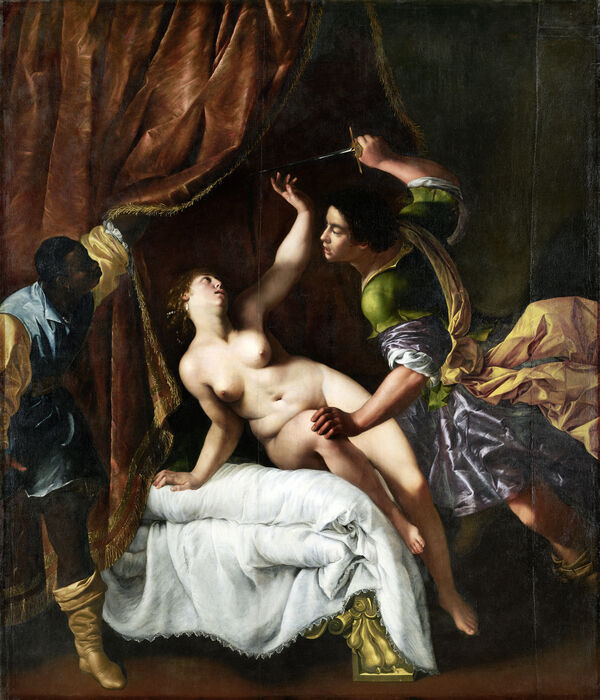
The story of the rape of the married and virtuous Lucretia by the king's son Tarquinius, her rebellion against her attacker and her subsequent suicide is part of the founding myth of the Roman Republic. Artemisia Gentileschi depicts the moment when Tarquinius threatens to murder Lucretia and a slave and to falsely accuse her of adultery if she does not give herself to him. The depiction of the servant may be based on an Italian folk song from the late 15th century. This song mentions a black slave, presumably to heighten the drama. Gentileschi shows him as both an accomplice and a victim. Unlike contemporary paintings of the same motif, a black person is shown as an accomplice instead of a white person. This suggests that the depiction reflects the racism typical of the time.
Acquired by Frederick the Great, the painting has been on display in the Upper Gallery of the New Palace since 1768. However, it was not correctly attributed to Artemisia Gentileschi until the 20th century. Pigment analysis indicates that it was created between 1627 and 1630.